
Project Description
Telematic System for Athens Municipality Schools
The Pilot programs of the Municipality of Athens are creating the first Schools in Greece with technical intelligence. They now have the capability to:
- record the consumption of electrical appliances and lighting fixtures;
- secure and protect sensitive electrical devices;
- manage energy with a focus on ecology and savings;
- provide safety and comfort to teachers and students.
System Implementation
The GEYER FIBARO system has been installed in 5 schools for the purpose of remote or local management, as well as saving energy and money.
In each school, the following have been installed:
- a central unit for its remote management, with the ability to monitor consumption in real-time, as well as create automation scenarios.
- 15 modules, in all classrooms, which supervise the lighting (fluorescent lamps with mechanical transformers), allowing for existing local management as well as remote management via computer/mobile phone, and measurement of energy consumption at the given time.
- 15 smart plugs for the purpose of consumption measurement, energy saving, and the protection of sensitive electrical devices such as computers, video projectors, kettles, etc.
The basic functions of the system, and the benefits for the schools and, by extension, the Municipality of Athens, are described below.
1. Energy Saving and Ecology
All electrical devices in the school, such as computers, projectors, printers, air conditioners, televisions, forgotten chargers, etc., will no longer remain in standby mode, but will automatically shut down during hours when the school is closed and automatically turn on during hours when the school is operational.
Lights will be adjusted according to the school’s needs and will not operate unnecessarily. Corridors that are naturally lit will not be illuminated with lamps or fixtures if the sun is shining outside. External lights will not turn on during the day. Classrooms with double lighting lines will be able to turn their lights on and off depending on natural lighting conditions.
Finally, by creating the appropriate automation scenarios, it will be possible to turn off forgotten lights and electrical appliances when the school is closed.
2. Protection of Sensitive Electrical Devices
Due to the ability to isolate sensitive devices from the electrical network, their lifespan is significantly increased.
This is achieved because the smart plug of the GEYER FIBARO system will mediate between the device and the electrical network, rendering the device completely inactive during hours when the school is closed, thereby protecting it from network overvoltages, lightning strikes, etc.
3. Safety and Comfort
Every installed smart plug has a light indicator (LED light ring) that changes color, depending on the electrical load passing through it. This determines which electrical appliances are ecological, with low energy consumption, and which are energy-intensive, due to high WATT consumption. If a high-consumption device is used, the GEYER FIBARO smart plug recognizes it, changes color, and in cases of risk, stops supplying power to it, providing protection against fire, cable overheating, and so on.
Also, every installed wall switch can be adapted to the specific needs of the user. For example, the teachers’ office switch has been programmed so that a single press turns off the lights in that specific area (a function that was used before the new installation), while a long press issues a command to turn off all lights in the classrooms via wireless communication.
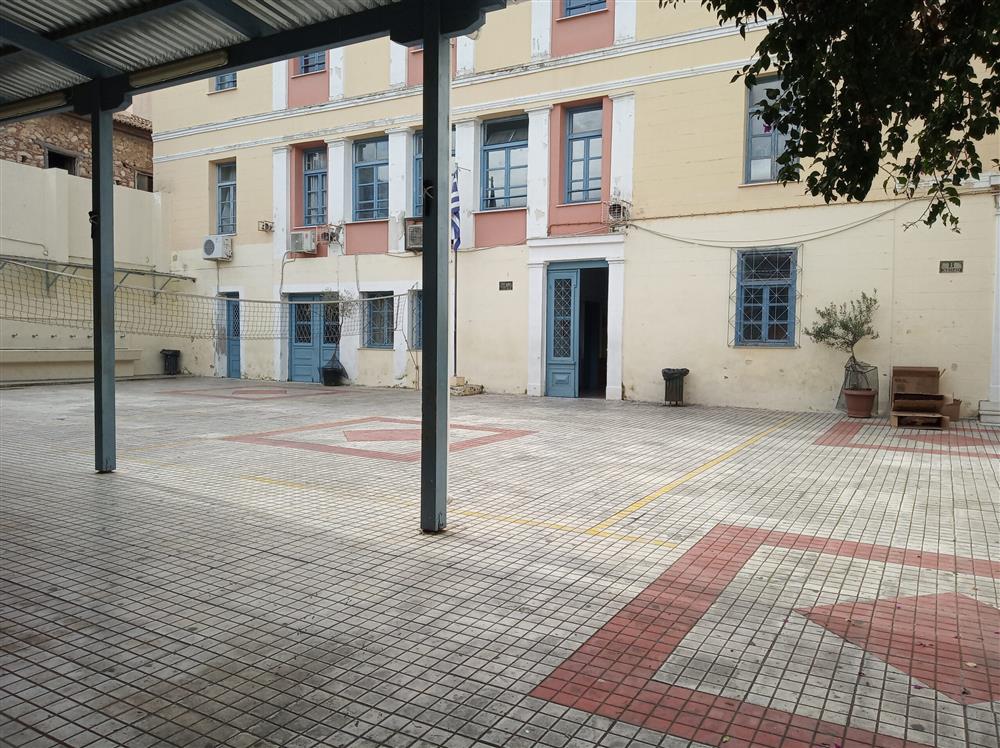
Illustrative Example: 43rd General Lyceum of Athens Asprogeraka
The situation before the installation of the GEYER FIBARO System:
Classrooms did not have switches to turn on the lights. Lights were turned on by teachers in the morning by lifting the main fuse in the electrical panel. This meant that lighting came on in all classrooms and corridors, regardless of whether these areas were being used. The lights remained on until a teacher, late in the afternoon, closed the main fuse when all classrooms were empty.
The situation after the installation of the GEYER FIBARO System:
Lighting in the corridors turns on only when necessary, meaning only when sunlight is insufficient. An external smart plug and button were installed in each classroom, and now the teacher can control the corresponding lights in their classroom without affecting the lighting in the other classes and without needing to go to the electrical panel. This conversion was achieved without any additional electrical work or cable routing.
4. Presence Simulation to Deter Intruders
There is the possibility of creating scenarios so that some lights in the school turn on and off automatically and at non-specified intervals, in order to simulate continuous presence, thus deterring any prospective intruder from entering the school premises.
5. Consumption Recording and Evaluation
Through the system, it is possible to monitor the consumption of lighting and electrical devices where the GEYER FIBARO smart system has been installed. In addition to momentary consumption, hourly, weekly, monthly, and annual consumption of the devices can be monitored. Furthermore, consumption can be displayed in values, showing the expenditure we have for each consumption. Finally, through appropriate charts, devices and lights with high consumption can be displayed for the purpose of replacement. This usually happens with lights due to their age.
6. Remote Management – Telematic System
Remote monitoring and management of such a smart School can be done from any computer, tablet, or mobile phone, from anywhere in the world and by multiple users simultaneously. To gain remote access, a user simply needs to have an account created by filling in an email and password, and be accepted as a user by the system administrator. Usually, the Principal is designated as the administrator. The administrator can delete and create as many users as needed, provide them with limited rights to use the application, and grant access to specific areas of the installation. For example, the computer science teacher may have remote access only to the lighting and electrical devices in the computer science lab. It is also possible to monitor and manage in real-time which devices/lights are on or off, when they were last activated, for how long they remained active, and who activated them (e.g., User 1 or the administrator).
Finally, the administrator can manage the system’s scenarios or create new automations that are integrated according to the needs of the teachers and students.
7. Communication and User Friendliness
In such a Smart System, two-way communication between the system and its users could not be missing. The system can notify via email or the mobile application about any or all selected events, such as a plug having an excessive load or some lights in a classroom being burned out. There is also the possibility for the system to request confirmation from the administrator before every action, such as, “Should I turn off the corridor lights because it is sunny outside?”
Finally, the system provides the user with an easy, understandable, and highly capable management environment, thus making system control very simple.
8. System Expansion Capabilities
Automatic Heating Control
Ability to remotely activate and deactivate the heating system, as well as monitor the temperature of each room.
Automatic Oil Control
Monitoring of oil level and the ability to notify in case of low level.
Alarm System Integration
Ability to remotely arm and disarm the alarm, notification in case of violation, and creation of various panic scenarios involving the lights.
Video Intercom System
Ability to check the camera at the school entrance via monitor or mobile phone and the ability to remotely open the door.
Now, with the collaboration of the Municipality of Athens – GEYER HELLAS, teachers and students no longer adapt to the requirements of an old school, but the school is modernized and adapts to their needs.
